Rules of Ludo
Four players race four pieces each around the board. The first to get all four home wins.
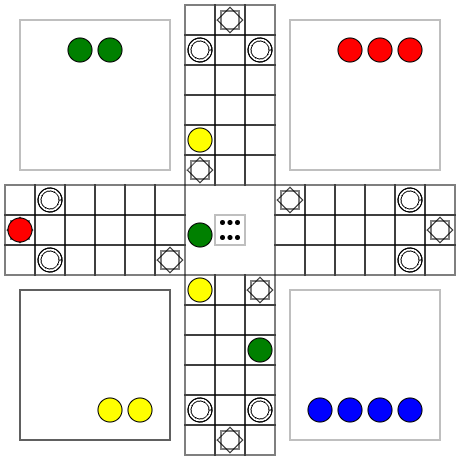
On your turn
- You roll one die, and choose which piece to move.
- You don't have to move. You can pass.
Getting out
- A piece leaves its corner only on a 6.
- If you have nothing on the board to move, you get two extra rolls to try for that 6.
- Your entry square is a globe (see below), so you can't come out if someone is already standing on it.
Going around
- Stars (the pointy squares): land on one, and you jump straight to the next star.
- Globes (the double circles): a piece on a globe is safe.
- The center row: after a lap, your piece turns into your own row towards the middle. Nobody else can go there.
- Getting home: you don't need an exact roll. If you roll too much, your piece still gets home.
Hitting
- Only one piece can stand on a square.
- Land on someone, and they go back to their corner. That's true for your own pieces too, so watch out.
- Land on a piece that's on a globe, and your piece goes back to the corner instead.
Winning
- The first player with all four pieces home wins the game.
- A game stops after 800 turns in total. If nobody is home by then, nobody wins.
Isn't this Parcheesi? The game goes by many names, with many small changes to the rules. In Germany it's Mensch ärgere dich nicht, "don't get annoyed, mate". Ludo is what we call it in Denmark and the UK, and it's shorter.